How Does an Air Fryer Work? The Fan, the Element and Why Food Gets Crisp
An air fryer works by heating air with an electric element at the top of a small chamber and using a powerful fan to drive that hot air around and up through a perforated basket, which dries and browns the surface of food far faster than a conventional oven. It is a compact convection oven, not a fryer, and thinking of it that way tells you how to load it, how much oil to use and when to shake the basket.
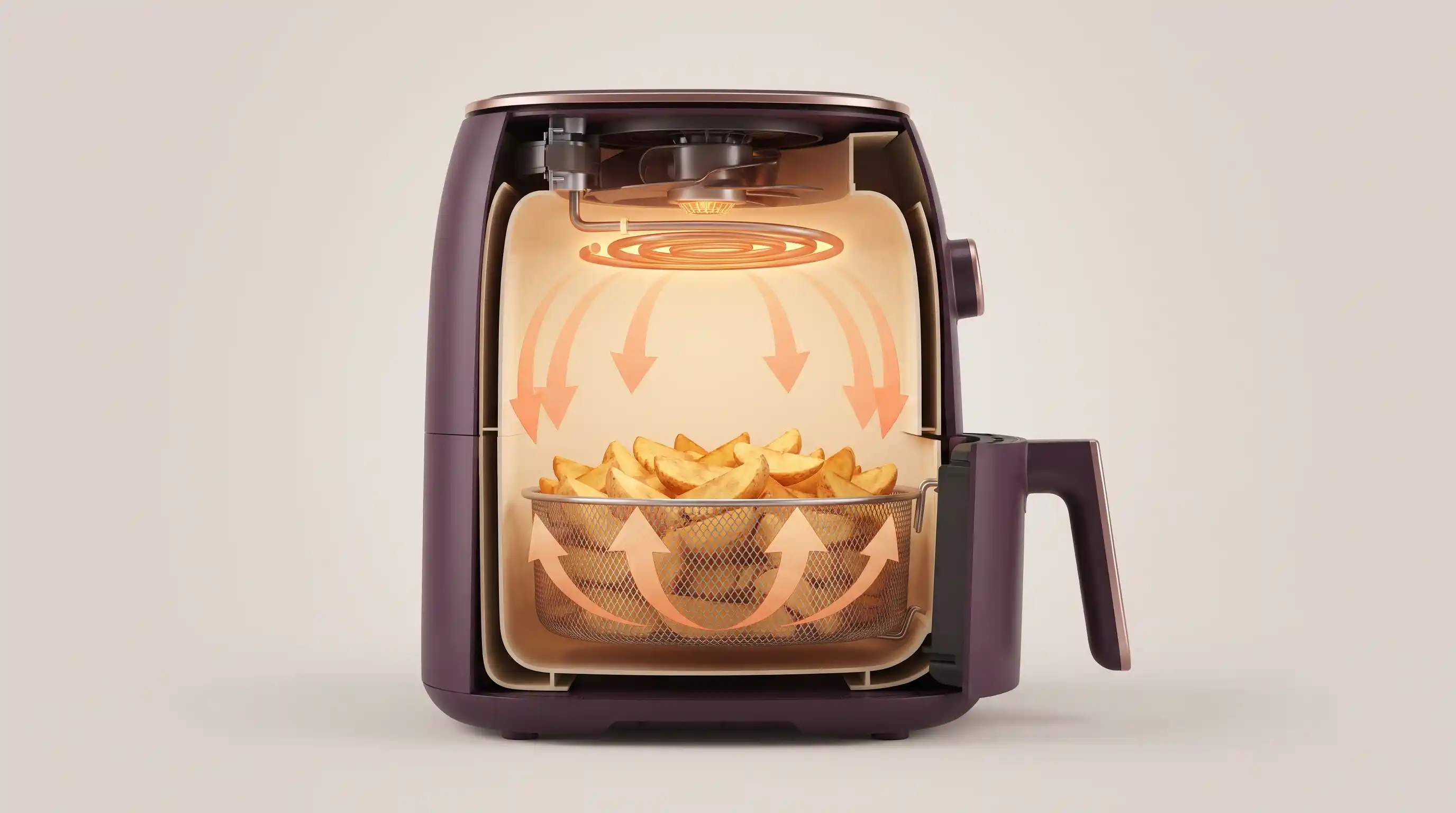
How an Air Fryer Cooks Food, Step by Step
An air fryer is a countertop convection oven with a small cooking chamber and a strong fan. The USDA Food Safety and Inspection Service describes it in those terms. Most everyday cooking in one happens at 180 to 200°C (350 to 400°F), and nothing is fried in oil. The "frying" is the crisp, browned surface that fast-moving hot air produces.
Here is what happens from the moment you press start on a typical basket model:
- You set a temperature. Most basket air fryers run from about 80°C (175°F) up to 200°C (400°F), and some go to 230°C (450°F).
- The heating element heats up. It is a coiled metal tube fixed in the lid, a few centimetres above the basket. It heats the air passing over it and also radiates heat straight down onto the top of the food, which is why the top layer always browns first.
- The fan moves the air. A fan sits directly above the element. It pulls air up through the hot coil and pushes it out and down the inside walls of the drawer.
- The drawer turns the air around. At the bottom, the shaped base of the drawer redirects that air upwards through the holes or mesh of the basket, so hot air flows across the underside and through the gaps between pieces of food.
- A thermostat holds the temperature. The element switches on and off to stay near your set point. The fan keeps running when the element cycles off, which is why the sound stays the same while the orange glow comes and goes.
- Moist air leaves through a rear vent. Water evaporating from the food escapes as steam at the back. That vent is part of how the food dries and crisps, so it needs clear space behind it.
What Is Inside an Air Fryer?
Every basket air fryer, whatever the brand, has the same core parts:
- Heating element. A metal-sheathed resistance coil, usually in the lid above the food. It is the only heat source.
- Fan and motor. Mounted above the element. The fan is what separates an air fryer from a small countertop oven: it moves a lot of air relative to the size of the chamber.
- Drawer (outer pan). Catches fat and crumbs and shapes the airflow. Its base is often moulded with ridges or a raised star pattern that pushes air back upwards.
- Basket or crisper plate. Perforated or mesh, so air reaches the underside of the food. Food sits on it, never directly in the drawer.
- Thermostat and timer. Control the element. Digital models add presets, which are just stored time and temperature combinations.
- Exhaust vent. At the back or top. Releases steam and some heat.
- Insulated housing. Keeps the outside cool enough to touch and the heat concentrated inside.
There is no microwave emitter and nothing more exotic than an element and a fan. What makes it cook differently from an oven is the proportions: a big fan, a small box and an element only a few centimetres from the food.
Why Does Moving Air Brown Food So Fast?
Moving hot air transfers heat to food much faster than still hot air at the same temperature, and it carries moisture away from the surface as it does. Those two effects together explain almost everything about air frying.
It strips away the insulating layer. Any food in a hot oven is wrapped in a thin layer of cooler, humid air created by the moisture leaving it. That layer slows heat getting in. A fan blows it away continuously, so the surface sees the full temperature of the chamber. It is the same physics as wind chill, running in reverse.
It dries the surface first. Browning cannot start while the surface is wet, because water holds the surface near 100°C (212°F). The Maillard reaction, which creates the brown colour and roasted flavour on chicken skin, potatoes and breadcrumbs, only gets going quickly once the surface dries and climbs well above that, roughly from 140°C (285°F) upwards. Fast airflow gets the surface dry sooner, so browning starts sooner.
The chamber is tiny. A 5 to 6 litre basket holds a fraction of the air in a full-size oven, and the food sits only a few centimetres from the element. There is very little to heat up, which is why an air fryer reaches temperature in two or three minutes while an oven takes ten or more.
This also tells you how to get good results:
- Dry the food. Pat chicken, fish and rinsed vegetables dry with kitchen paper. Surface water is the first thing the air has to remove.
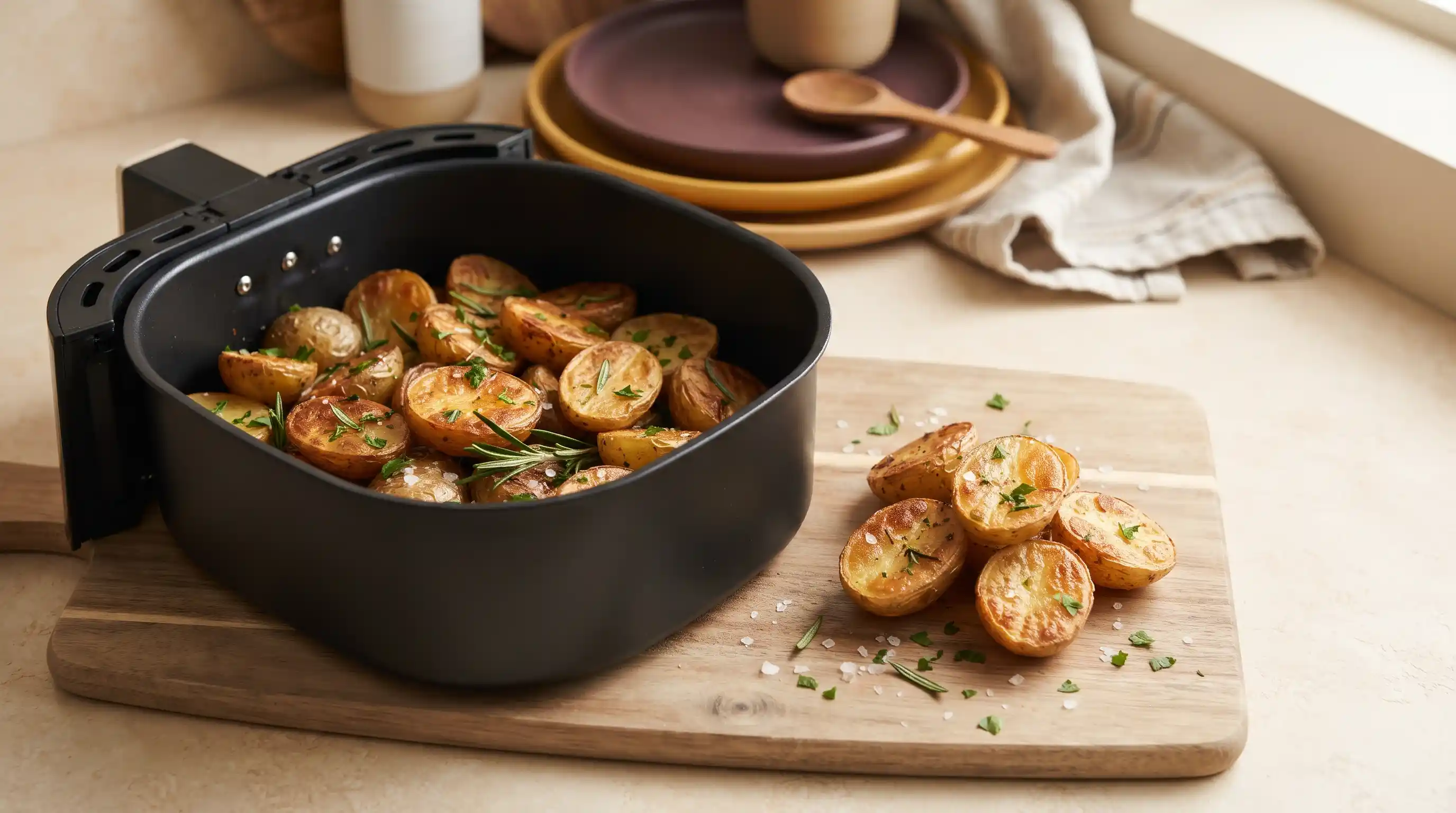
- Cut evenly. Pieces of the same size dry and brown at the same rate. For air fryer potatoes, 2.5 cm cubes work well because the outside crisps in about the time the middle takes to soften.
- Leave gaps. Air has to reach each surface. Pieces pressed together steam each other instead of browning.
Air Fryer vs Oven vs Deep Fryer
An air fryer sits between a fan oven and a deep fryer. It uses air like an oven, but moves it hard enough, in a small enough space, to get closer to fried texture on many foods.
| Air fryer (5–6 L basket) | Fan (convection) oven | Deep fryer | |
|---|---|---|---|
| How heat reaches food | Fast hot air plus radiant heat from an element just above | Slower hot air in a large cavity | Hot oil touching every surface |
| Typical cooking temperature | 160–200°C (325–400°F) | 160–220°C (325–425°F) | 170–190°C (340–375°F) oil |
| Heating up | 2–5 minutes, sometimes optional | 10–20 minutes | 10–15 minutes or more for the oil |
| Oil per batch | None to 1 tbsp (15 ml) | 1–3 tbsp per tray | 2–4 litres in the pan, some absorbed |
| Capacity | 2–4 portions per batch | A full family meal, large roasts | Small batches |
| Best at | Small crisp items, reheating fried food, skin-on chicken | Large quantities, roasts, cakes, tray bakes | Wet batters, doughnuts, tempura |
| Weak at | Wet batter, large roasts, cooking for six or more | Crisping quickly | Clean-up, oil use |
Is an air fryer just a small convection oven?
Mechanically, yes. A fan oven also has an element and a fan. The differences are scale and placement. In an air fryer the fan is large relative to the space, the element is much closer to the food, and the basket lets air under the food rather than leaving it sitting on a solid tray. That is why a bag of frozen fries that takes 25 minutes in an oven usually takes 12 to 18 in an air fryer, depending on the cut, and comes out crisper.
The "air fry" setting on a full-size oven uses the oven's own fan with a perforated tray. It works, but expect to need more time and a hotter setting than a basket air fryer, because the food is further from the element and the air is spread over a bigger space.
In a Gulf kitchen in July, the size difference matters for another reason. A full oven running for 40 minutes heats the whole room and works the air conditioning hard; an air fryer's small, insulated chamber puts far less heat into the kitchen.
How is an air fryer different from a deep fryer?
Oil transfers heat far more efficiently than air. At 180°C it surrounds every surface, flashes surface moisture to steam instantly and sets a crust within seconds. Air at 200°C cannot match that, so an air fryer browns from the outside in more gradually and produces a drier, slightly firmer crust.
Two consequences matter in the kitchen:
- Wet batters fail. In a deep fryer, batter sets the instant it hits the oil. In an air fryer it drips through the basket before it can set. Breadcrumb coatings and dry flour dredges work; thin pouring batters do not.
- Fried food absorbs oil; air-fried food only has what you add. That is the source of the calorie difference covered below.
Does an Air Fryer Use Oil?
An air fryer does not need any oil to run, but most foods brown and crisp better with a small amount: 1 teaspoon to 1 tablespoon (5 to 15 ml) per 500g (1 lb) of raw potatoes or vegetables is enough.
Oil helps for two reasons. It conducts heat into every small crack and ridge of the food's surface, where air alone reaches less evenly. And a thin film of fat browns faster than a dry surface, so breadcrumbs go golden instead of staying pale and powdery.
When to use none at all:
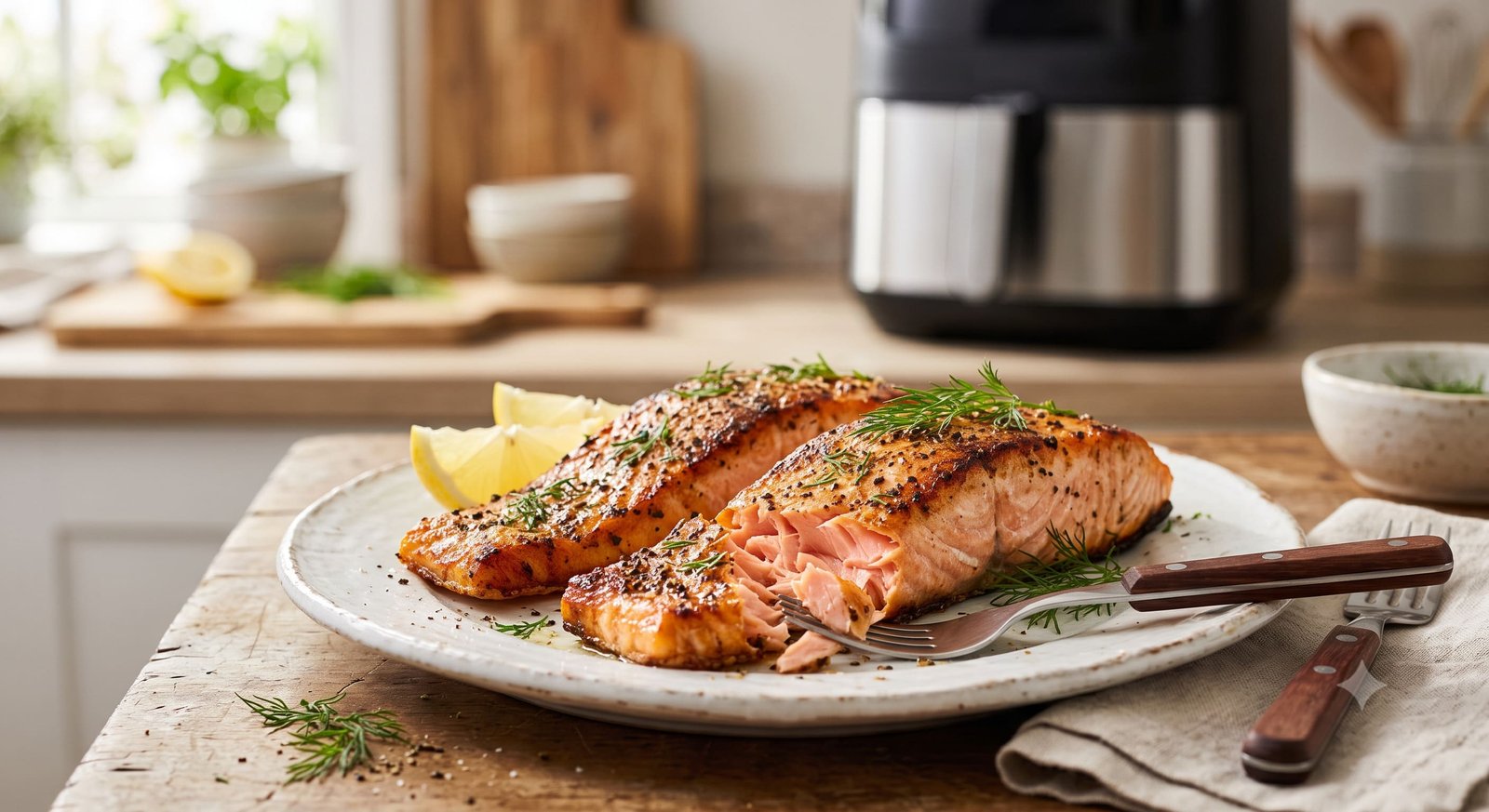
- Foods that already contain fat, such as skin-on chicken thighs and chicken wings, halal beef sausages and salmon fillets. Their own fat renders out and does the job.
- Frozen foods that were par-fried at the factory, such as most frozen fries, nuggets and spring rolls. Check the pack: many say "no oil needed".
How to add it:
- Toss in a bowl first, then tip into the basket. Pouring oil into the basket wastes most of it into the drawer, where it smokes.
- Use a pump mister or a brush rather than an aerosol can. Several manufacturers' manuals advise against aerosol cooking sprays, which can leave a sticky build-up on non-stick coatings.
- Choose an oil with a high smoke point. Sunflower, rapeseed (canola), light olive oil and avocado oil all handle 200°C comfortably.
Is Air Frying Healthier?
Compared with deep frying, usually yes, because it uses a small fraction of the oil. Compared with roasting the same food in an oven with the same spoonful of oil, there is no meaningful difference: the air fryer changes the cooking method, not the food.
What the sources say:
- Fewer calories than deep frying. Cleveland Clinic's article on air fryers says they need about a tablespoon of oil and may cut the calories you would get from deep frying the same food by up to 80%, because the food is not soaking up frying oil.
- Less acrylamide than deep frying, in one study. Acrylamide forms when starchy foods such as potatoes and bread are cooked at high temperature. Sansano and colleagues, writing in the Journal of Food Science in 2015, found that air-frying potato strips cut acrylamide by roughly 90% compared with deep-oil frying. That was a lab study at set times and temperatures, not a guarantee for every batch.
- Acrylamide still forms. Cleveland Clinic makes the same point: some is still present in air-fried food. The UK Food Standards Agency advises aiming for a golden yellow colour or lighter when frying, baking, toasting or roasting starchy foods. Dark brown fries are dark brown fries, whatever cooked them.
What it does not do:
- It does not remove fat that is already in the food. A frozen breaded nugget is nutritionally the same nugget whether it is air fried or oven baked.
- It is not risk-free. Cleveland Clinic cites studies finding that air frying fish can raise levels of cholesterol oxidation products, and notes that polycyclic aromatic hydrocarbons (PAHs) can still form, though at far lower levels than in deep frying. Keep the drawer free of old fat and do not run fatty food at maximum heat for longer than it needs.
So if the air fryer replaces a deep fryer or takeaway fried chicken, you are eating much less oil. If it replaces a tray of vegetables roasted with a spoonful of oil, it mainly saves time and keeps the kitchen cooler.
Do You Need to Preheat an Air Fryer?
Preheat for 3 to 5 minutes for anything breaded, frozen or meant to brown hard, and skip it for reheating or long cooks where a few minutes do not matter. If you skip preheating, add 2 to 3 minutes to the cooking time.
Preheating matters most when the surface needs to start setting the moment food goes in:
- Breaded and frozen foods. A hot basket sets the coating before it softens from thawing.
- Searing. Cubes of beef for steak bites need a hot basket to brown before the centre overcooks.
- Pastry. Puff pastry and filo rise and crisp better when they meet heat immediately.
It matters least for whole baked potatoes, reheating and anything cooking for 30 minutes or more. Without a preheat button, run the empty air fryer at your cooking temperature for 3 minutes. Do not preheat with an empty parchment liner in the basket: with no food to weigh it down, the fan can lift it into the element.
Why Recipes Tell You to Shake the Basket
You shake or turn food because hot air and radiant heat hit the top layer hardest. Pieces on top brown, pieces underneath and touching each other stay paler and softer. Shaking moves everything around so each surface gets time in the airflow.
A workable rule:
- Shake small pieces (fries, potato cubes, chickpeas, nuggets, broccoli florets) every 5 to 8 minutes.
- Flip large pieces once (chicken thighs, fish fillets, burgers, breaded cutlets) at the halfway point with tongs.
- Do not shake breaded food in the first few minutes, before the coating has set, or delicate items such as flaky fish, quiche, cakes and cookies.
Shaking does not fix overloading. The USDA notes that overcrowding the basket leads to uneven cooking. In a 5 to 6 litre basket, about 750g (1⅔ lb) of cut potatoes is the practical limit if you want them crisp; beyond that, cook in two batches. A single layer with small gaps is ideal for anything that is meant to brown all over.
Basket, Dual-Zone and Oven-Style Air Fryers
All air fryers use the same element-and-fan principle, but the layout changes how you cook.
- Single basket (2 to 7 litres). The most efficient design. Recipes on this site assume a 5 to 6 litre basket. In a 2 to 3 litre model, keep the same temperatures and cook smaller batches.
- Dual-zone (two drawers). Each drawer has its own element and fan, so each behaves like a smaller single basket. Split batches between them and use the "sync" function to finish two foods together.
- Oven-style with racks. More capacity, but the top rack sits closer to the element and browns faster. Add 2 to 5 minutes to basket times and swap the trays halfway.
- Air fry mode on a full oven or combination microwave. Same principle in a much larger space, so expect longer times.
Common Problems Explained by How It Works
Most air fryer failures come down to airflow, distance from the element or fat in the drawer.
| Problem | Why it happens | Fix |
|---|---|---|
| Pale, soft food | Basket overloaded, so steam is trapped and air cannot reach each surface | Cook in batches in a single layer; pat food dry |
| Burnt top, undercooked middle | Thick food too close to the element at too high a heat | Drop 15–20°C, cook longer and flip halfway |
| Patchy, powdery breadcrumbs | Dry spots with no fat to conduct heat | Mist the coating lightly with oil before cooking and after flipping |
| White smoke | Fat dripping onto the hot drawer, or old grease burning | Pour off fat between batches and keep the drawer clean |
| Black smoke or burning smell | Food or paper touching the element | Switch off and unplug, then check the lid |
| Light food blown around | Fan lifts bread slices, leafy greens or unweighted parchment | Weigh down with food or a trivet, and never preheat with loose liners |
| Food cooks faster than the recipe says | Smaller basket or a more powerful unit | Check 3–5 minutes early the first time you cook something |
If smoke is a regular problem, grease has probably built up on the element or under the basket. Our guide on how to clean an air fryer covers the element and drawer step by step.
Once you know the mechanics, the next question is what is worth putting in it. See our guide to what to cook, and what to avoid, in an air fryer, and the frozen food time and temperature chart for converting pack instructions.
Frequently Asked Questions
Does an air fryer actually fry food?
No. An air fryer bakes food in fast-moving hot air, which is convection cooking. It produces a crisp, browned surface similar to frying on breaded and starchy foods, but the food never sits in oil. The crust is drier and slightly firmer than deep-fried food, and wet batters do not work.
Why does an air fryer cook so fast?
An air fryer cooks fast because its chamber is small, the element sits a few centimetres above the food and a strong fan keeps hot air moving across every surface. Moving air strips away the cooler, humid layer around food, so heat gets in quicker and the surface dries and browns sooner than in an oven.
Does an air fryer use radiation like a microwave?
No. An air fryer has no microwave emitter. It heats food with an electric element and a fan, the same way a fan oven does. The element does give off radiant heat, the ordinary infrared warmth you feel from a grill, which is why the top of the food browns first.
How hot does an air fryer get?
Most basket air fryers reach a maximum of 200°C (400°F), and some models go to 230°C (450°F). The lowest settings are usually around 80°C (175°F) for dehydrating or keeping food warm. Most everyday cooking happens between 180°C and 200°C (350°F and 400°F).
Do you need to put oil in an air fryer?
You do not need oil for the air fryer to work, and fatty or par-fried frozen foods need none. For raw potatoes, vegetables and breadcrumb coatings, 1 teaspoon to 1 tablespoon of oil per 500g improves browning. Toss food in the oil in a bowl rather than pouring it into the basket.
Do you have to preheat an air fryer?
Not always. Preheating for 3 to 5 minutes helps breaded, frozen and seared foods set and brown quickly. For reheating or long cooks such as whole potatoes it makes little difference. If you skip preheating, add 2 to 3 minutes to the cooking time and check for doneness.
Do you need to put something under an air fryer?
Place an air fryer on a flat, heat-resistant worktop with space around it, especially behind the rear vent, which releases hot air and steam. Keep it away from walls, curtains and cabinets above. A wooden board or heatproof mat underneath is sensible on surfaces that mark easily. Check your manual for exact clearances.
Is it bad to use an air fryer every day?
Not in itself. Air fryers are built for daily use, and what matters for your diet is what you cook in it, not how often. It uses far less oil than deep frying. Keep starchy foods golden rather than dark brown, as the UK Food Standards Agency advises to limit acrylamide, and clean the drawer regularly so old fat does not smoke.